
 |  |  |  |
Super Real Mahjong Premium Collection review by Darius
Before I start talking about the actual game I just want to make one thing clear: you are here for the booty. Don't fool yourself into thinking that you're looking for the thrill of experiencing video mahjong because if that were true you'd have gotten Mahjong Anywhere instead. You only considered this game for the chance to see nak'd anime babes on the NGPC just like everyone else. But is that so bad? Well, as it turns out it is not. Once you get past the shallowness of playing strip mahjong and the moderate learning curve there is quite a bit of game play here. It all depends on how badly you want it.
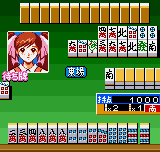
Graphics Probably the first thing on everyone's mind is: "How much skin do you get to see?" Flat out, there is definitely cleavage in the game. All of the girls are drawn in intricate anime detail with a lot of sassy posturing and demeanor. If you want an example of what they look like you can check out any of the games in the Super Real Mahjong series by Seta. Heck, all of the strip scene images are direct sprite rips from SRMJ parts 5-7. In terms of animation though there is obviously a bit of loss. The original games were on CD so it was easy to have full screen animation at all times. In order to get everything onto the cart, Seta had to take out a lot of frames of animation keeping only the most important parts fully animated. The rest of the time they just pan over still images that have been touched up with accenting lines and extra shading. I compared the animation between this version and the latest CD version in the series and concluded that for what animation is intact it's spot on the same. Other than the artwork, the only other important graphical element to this game is the tile distinction. Even though the tiles in the game are quite small, each is easily distinguishable from the rest. The only trick then is to learn what each tile means.
Sound
Another area of the game that was borrowed from its previous incarnations is the BGM. Each girl has their own mix of musical themes that were taken directly from their original games. As a whole I found all of them very catchy and hum-able. The music certainly fits with the genre of cute & bubbly anime girls. Sound effects are pretty limited in the game, however, since this is essentially a card game. Most of the time you'll hear the clacking of mahjong tiles which while a little annoying is not overly so. Probably the most enjoyable sound effects are the voice clips. Besides making the player feel all cool inside for hearing speech in a NGPC game, it also helps identify just what actions have been declared. When trying to learn the game this is especially helpful.
Presentation
There are 2 different modes to play through: story and challenge. In story mode you'll follow the escapades each of the girls as you try to defeat them in round after round of strip mahjong. Upon completion of each round of play, the girls will remove one article of clothing per win. In general you'll have to win about 4-5 rounds to get some action. Once you finish each girl's individual story the game will save that girls strip scene in a gallery mode so that you can go see them again and again and again. Challenge mode is just that: you challenge a specific girl to a few rounds of mahjong. Once you've won, the computer will reveal a picture of that girl hidden by panels. Based on your score in challenge mode, victory will remove a certain number of these panels until the entire picture is revealed. In my experience I've gotten as many as 15/20 panels in one game and as few as 3/20 based on my performance. These too are unlocked in the gallery. In total there are 7 girls to unlock in both story & challenge mode. If you include the 1 hidden girl (yep, there's one of those too), we're talking replay that is a cross between MotM & CFC. You do the math.
Game play
Like I said before, the meat and potatoes of this game boils down to a card game. The best description for it would be a variation on Gin Rummy. Each turn you end up picking up a tile and discarding one in an effort to try and collect a winning hand of 14 tiles, after which you can declare victory. The basic rules for a winning hand are that it must contain 1 (and only 1) pair and 4 sets of 3 tiles (either a straight run in the same suite or 3 of a kind). In attempting to make a winning hand you are also able to use the last tile that your opponent discarded to form a set. It may sound confusing, but once you get the hang of it, it becomes second nature. But as I've re-iterated throughout my entire schlemiel, there is some definite work involved in learning the game. For starters, there is a unique foreign set of "cards" for you to recognize and remember. Most of these are not that difficult to decipher since you can just count the additions just like Roman numerals, but others are a little trickier. Most tiles have a numerical value ranging from 1-9, whereas others simply have an interpretive meaning (eg. Face cards, but without the number value). To complicate matters there are specialty hands which in poker terms are akin to straight flushes or full houses. I find that these specialties are so hard to remember (too many) that I've limited my strategies to mostly basic hands. The last major obstacle you'll come across is that the menus are in japa-freakin-ese. The in-game menus are your lifelines to playing the game and not knowing what they mean leaves you dead in the water. As I mentioned above, you have to declare victory as well as other game actions. If you don't know which option is the correct declaration then you'll probably end up getting screwed by the computer. On the inevitable side of things though, since the computer knows all the specialty hands as well as basic ones you'll probably end up getting screwed anyways. The true test of the game then is how determined you are to get some T&A. If you can endure the humiliation of defeat for however long it takes you to win, then you're doing all right. I suppose it helps that in practice the actual game play is super addicting. But don't lose track of your goal; it's skin or nothin'!
Overall
I've probably been a little harsh in describing the uphill battle to learn the intricacies of this game, but that's how it seemed to me. Of course, all of the problems I've talked about above can be fixed by a good FAQ or two. That means research for the lazy minded which is where the work comes in. In all honesty, I had no clue how to play mahjong before this game and in just under 2 days was slugging my way through. It only took about a week of constant trial and error to get some results so take my exaggeration of the difficulty level, as you will. The point is that I had incentive to play, and that's really what kept me going in the initial battles. It's kind of like CFC where the first few matches were learning how much you sucked, but also learning how badly you wanted to win. So in closing it's a pretty game with nice sound effects, addictive play, and some bitchin' AI. Most people will probably give up on trying to win once they've been trounced for the thousandth time, but for the pervert gamer who sticks to their guns there will be redemption in the wake of victory. This is also likely to be one of the last good NGPC games ever. So get your copy, get some FAQs, and get moving.
