 |  |  |
Shanghai Mini review by Paleface
Shanghai. You've got a stack of tiles arranged in a Chinese Zodiacal shape and you remove pairs until all the tiles are gone. Simple, basic puzzle game. How fun can that be? Well, throw in some upbeat tunes, secret agents and space aliens and it's actually quite a bit of fun.
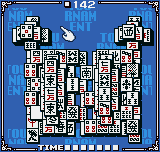
The graphics will not impress but they do the job. The neutral toned, static backgrounds feel pretty dull but then again, they don't distract from the tiles. Which is good because the tiles will not draw your eye a great deal on their own as they are fairly tiny with uniform red and black characters on a white background. It sure would have been nice to have the choice of a few different tilesets and backgrounds. That would have been really nice, in face. The only set available has some odd tiles that match ones with different pictures--this gets a little confusing especially in the heat of the action when you're already cross-eyed from squinting at tiles for an hour. Still, the graphics could not be called ugly, just bland and small.
The music surprises by setting an upbeat, Chinese tone that manages to keep me tapping my toes even though it repeats over and over. Catchy but not too obtrusive, the music makes good use of the hardware and sets the right mood for tile-matching fun. The tile picking and matching sounds themselves give pleasant feedback to your action and don't strike a false note. Sounds good.
The menu designs are scattered but make up for it by being fairly easy to read. The main menu has three large items. The first, ''Classic,'' presents you with randomly shuffled boards to clear, allowing you to pick from six arrangements and three difficulty levels. The six arrangements are okay but c'mon, that really isn't very many. More, give me more boards! On the plus side you can undo moves and have the CPU show you a match if you're stuck. Classic mode also features the NGPC's nifty autosave feature, so if you power down in the middle of a board, you'll be asked if you want to continue when you re-enter classic mode. Nifty-keen.
Gameplay itself involves picking pairs of tiles, of course. The tricky part comes in that each tile appears four times and you can't pick tiles under other tiles, so you can get stuck if the tiles you need for a match have other tiles on them. When this happens the computer tells you the jig is up and gives you the option to replay the table. This is cool 'cause you can learn from your previous errors and beat the table the next time around. Again, the only problem with Classic mode is the lack of table variety, although the random tile arrangements ensure that each match is at least a little different than the last.
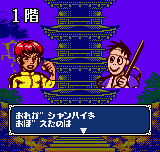
The second menu item, ''Tournament,'' is currently my favorite (and I haven't beaten it yet, so who knows what goodies come when that happens? Okay probably nothing but a little ''you're good'' message. Let me dream...). You enter a seemingly endless pagoda tower, getting challenged by a new opponent at each floor. They challenge you to beat their Shanghai board, of course. Whoever wrote this part had a lot of fun with the conversations as they get pretty wacky, with your character dishing out a good deal of sass at each new challenger. The challengers, starting with a pretty normal if rather odd-looking tower guard, quickly get very, very weird. Each board has a time limit with a good deal of tiles to clear and the matching action really gets nail-biting as you get close to the end of the clock, especially since the clock is shown in rough units so you never know exactly how many seconds are left. Match as fast as you can! Unfortunately, this mode lacks the autosave feature, giving a code you have to write down with each completed stage if you want to resume your progress later. I hate writing down codes. They're short, but still...
Dynasty, the third mode, pits you in split-screen action against an opponent, either human (via link cable) or CPU in three flavors of difficulty. The CPU can put up a tough fight but the challenge only lasts one board, kind of a downer. The action gets fairly frenetic: while it doesn't appear you can get stuck on these board with overlapping tiles, there are special animal tiles which, when matched, inflict punishment on the opponent in a variety of nefarious ways: the worst hides all your tile faces for a while so you have to match blind. Ack! The tough CPU opponent is incredibly hard but I can see how this game would be pretty fun with two players.
And that's it. More than you expected, eh? Providing classic puzzle action with some unexpected and fun twists, Shanghai Mini exceeded my expectations by a good deal. It doesn't look so great at first but give it a little time and you'll find the action proves surprisingly addicting, with the different modes offering a pace to suit your every mood. It all comes down to matching little white tiles, of course, but Shanghai Mini succeeds in making this fun in several different ways.
Score: 6/10