Samurai Shodown! 2 review by Archon
*Note: I don't have FF or KOFR2 or any other carts right now, so I'm giving a review that doesn't attempt to compare SS2 to them.
Summary: Excellent animation and a fighting engine worthy of a new incarnation of SS instead of a "portable-cut-down" version make this a must-buy for fans and a strong buy for people who like fighting games. Only two weaknesses are music and perhaps a slight slowing of pace from original SS game. I ended up liking this much better than the PSX SSIV.
Samurai Shodown 2 (Samurai Spirits 2) is a vs. fighting game that has quite a distinguished lineage, including SS 1-4, 64, and 64 II. Starting from the beginning of the series, the SS games have always emphasized armed (i.e. weapon combat) that was decidely different from the standard karate games out there. The main focus tended on making it more like a chess match than a hockey game; moves must be carefully thought out, and the penalty for button mashing strong attacks was huge. SS games also concentrated heavily on a very stylistic, heavily Japanese theme in character, music, and voice.
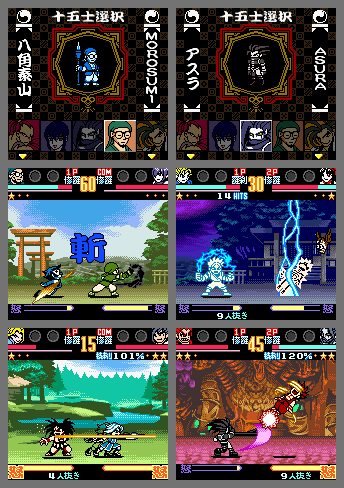
This translates excellently to the small screen. Graphics are large and well defined, and backgrounds are of good quality considering the amount of colors available. Like other NGPC games, this games appears to use a 2-bit plane for character sprites, thus characters are four colors, however, those colors are well used on most characters due to the monochromatic themes. Genjuro (slash) is especially excellent since they used one color for flesh tone. Other characters have that semi-black-and-white appearance that KOFR2 demonstrates. The animation is unbelievably excellent, better than the SNES version of SS IMHO. You can see smooth movement on the standing animations (Genj's POW "shudder" too), and though there are no voices, the end of round animations are mostly there. When you do a super move, a full color picture of your character appears in the background, and these pictures give you enough idea of what the character looks like so that you can identify with them. The graphics are detailed enough so you can see the backs of Genj's hanafuda cards when he throws them ("Gokou!") and Nak's hawk Mamahaha, her wolf (forgot the name), Galford's dog Poppy, and Rimururu's ice crystal were NOT taken out.
The sound is standard Gameboy-type fare. I know it's quite impossible to include all of those voices, but for fans, you probably won't mind, because you'll either hear the voices in your head (strong association), or you'll be saying them out loud. For non-fans, don't worry, the end-of-round comments are there and are fairly cool (japanese) or entertainingly zany (english). "Hit" sounds are fairly good, and I especially like the "clink" when Ukyo resheathes his sword.
The music...is a bit weird. All right, it's a weird that you can get used to, but it's not ideal music for a fighting game. The SS series always used very distinguishable japanese instruments, and while you can make a modulated sine wave sound a bit like a flute, you cannot make it sound like a shakuhachi. The music on some stages is also sometimes fairly quiet and slow, so you need to be a very mental fighter to appreciate those. Some stages, however, are recognizable from previous incarnations of the series and are reasonably toe-tapping.
However, I didn't buy it for the music. What really impressed me is the gameplay. I think that there's really a lot of people who prefer the KOF style of gameplay, however I liked the SS games much better in the arcade, and it is safe to say that the gameplay here is remarkably similar to the arcade, i.e. not as frantic as your typical Street F, though the buttons were really modified for NGPC use. The A button is used for short slash. Long A is used for a stronger slash. B on the ground is used to dodge (i.e. unlike arcade there are only two flavors of slash and no ground kick!). However, the buttons are used to their fullest. A is not the same slash as d+A, which is different than f+A, and different than f,f+A. B is dodge, but if you press f or d+B, you can parry high or low, or b+B starts a SCS combination attack that can fill your rage gauge, juggle the opponent, or cause a lot of damage. It appears to me that SNK really playtested this to death to delete the things people didn't use and improve the things that people did. Notice that there is now no weapon breaking, and I think no honorable suicide - perhaps people didn't use them enough.
The moves work really well and are easy to pull off, especially super moves. Some normal moves have incredible range, and you may be using them more than your special moves, which is what the SS games were all about. One thing I noticed is that the pace of the game was slowed slightly because there is a longer delay when you use a strong A and your enemy blocks it. That was probably adjusted because some characters have such huge range that it would be unfair if they could strike over and over from across the screen (i.e. Genjuro, Haoh).
What really impressed me is the incredible amount of gameplay content in this game. Longetivity is improved by cards that you have to collect. You gain cards by winning a match using your super or by defeating the sub-boss Gandara or the boss Yuga. There are only 4 cards for each character and fighting type (Slash/Bust). KOFfers might be disappointed, but that does make over a hundred cards total. You cannot use cards for one character on another character, however. You can equip two cards at a time, and there is always one card that improves attack power, one that improves defense, and two special move cards which either give you a new move or improve a move that you already have. Improving a move means actual new animation, not just making it faster or more powerful. As far as I've seen, cards do not "improve" or evolve. Each card also has a very nice picture (four types per character) and a quote which tells a little bit of story about the character...IMHO, a necessity considering the rich history that the SS series has. You can gain more than one card of a typ move lists on the web don't have the full story; each character usually has one or two moves not listed in the manual and remember that there are two cards that you can equip for improved moves for a character. Not only are there regular Ryu/Ken/Haohmaru uppercut and fireball type maneuvers, but there are also dash moves, teleports, unblockable moves, air throws, multi-part attacks, counterattacks, you name it.
Especially interesting: Hattori Hanzo (Rasetsu or Bust), listed with four moves in the manual, has 9 that I've found, plus his special. There is an air throw, two flavors of teleport (with two possible locations for each move), two throws, two multipart throws (one is a quadruple break, ow!), and a counterattack. Plus a card makes his special a multipart throw. Another example of a cool move is Sogetsu, who has a card with a "water gathering" move. When this move is performed, it creates a field of water so that he cannot block but attacks do not knock him down either, allowing you to instantly counterattack; this lasts until you turn it off. Correspondingly, Kazuki has a field of fire which adds flame to each of his normal attacks.
Finally, there are 15 characters (the boss Yuga is playable) and you can choose Bust or Slash for each one. SNK paid special attention here; some of the Bust/Slash are COMPLETELY different characters, For instance, Sogetsu and Kazuki Slash have swords, but the Bust versions have no swords...and thus completely different normal, special, super attacks and standing animations (no "missing sword" syndrome)! Nakoruru has an eagle or a wolf as companion (cute!), depending on Bust/Slash. We're not talking a Gameboy approach to making fighting games here.
Anyways, hope this review helped some of you make a decision. I'm happy with my purchase so far, and I hope to have this game mostly figured out before I go out and empty my wallet for KOF-R2. :)